Tuesday, December 26, 2017

Feast of Saint Stephen, First Martyr - The Power of Witness – Feast of St. Stephen

Jesus said to his disciples: “Beware of men, for they will hand you over to courts and scourge you in their synagogues, and you will be led before governors and kings for my sake as a witness before them and the pagans. When they hand you over, do not worry about how you are to speak or what you are to say. You will be given at that moment what you are to say. For it will not be you who speak but the Spirit of your Father speaking through you. Brother will hand over brother to death, and the father his child; children will rise up against parents and have them put to death. You will be hated by all because of my name, but whoever endures to the end will be saved.” 

Introductory Prayer: Lord, I open my heart to you on this new day. Because of your unfailing love for me, you deserve my deep gratitude and complete confidence in you, so I set my entire being at your disposal. Do with me what you wish. I know that you love me and that nothing that can truly harm me will happen as long as I keep striving to live in your love.

Petition: Lord, help me to experience your forgiveness and learn to forgive in return.

  1. “Do Not Hold This Sin Against Them!”These words of St. Stephen (Acts 7:60) repeat Christ’s last words on earth. He has entered into Christ’s heart. He is on fire for his Lord. This fire is making him pass through the same crucible of rejection and death that Christ passed through. And he is walking in the fire without being scorched. His heart burns so much for Christ that it cannot fester with hatred and despair. Like his Lord, he wants only the salvation of his persecutors. Am I letting my heart to be ignited with the flame of love that burns in that Child in the manger? Am I showing the zeal of love that is selfless service?
  1. The Case of Saul: The Acts of the Apostles records the approval of Stephen’s martyrdom by Saul. Saul was a man who thought he understood everything. He thought he knew how evil Stephen was and what a threat his teaching brought. His intentions seemed correct, but he was dead wrong. Saul will later speak of himself as someone born dead. He was dead –– dead in his soul – because he had missed the point. Yet God is merciful. Saul soon becomes St. Paul. Jesus accepts the prayer of Stephen just as the Father accepts the prayer of Jesus. We do not need to be afraid. God accepts our prayers, too. He will do marvels if we persevere in prayer and service.
  1. 3. Hard of Heart: We’re often pushed out of our comfort zone by Christ’s message. We are ready to be forgiven by Christ and by others, but it is not so easy to take the logical next step of quickly and easily forgiving others. To become a forgiving St. Stephen we need to keep in mind that we, too, are Saul. The Christmas Season is a perfect time for a change of heart. By contemplating today the loving face of God in that child in the manger we can experience his tender, infinite love for us. Anchored in his friendship we can gain the magnanimity of heart to set aside any ill will from past injuries and desire for everyone to find the peace and joy that only comes from knowing the Word Incarnate.

Conversation with Christ: Lord, thank you for the example of St. Stephen, the first martyr of your young Church. On this day after your birth, you also show me the birth of total courage in love. I believe that I am safe in your arms no matter how hard the difficulties. I believe that you entrust me with your mission. Today I renew the commitment to be faithful to my mission as a Christian and an apostle “till death on the battlefield.” Jesus, you are my Lord. I will follow you.

Resolution: Today I will look for the positive side in everyone I meet. I will look beyond their limitations. I will forgive anyone who might offend me.

Monday, December 25, 2017

The Nativity of the Lord (Christmas) - Flesh, Glory, Grace

In the beginning was the Word, and the Word was with God, and the Word was God. He was in the beginning with God. All things came to be through him, and without him nothing came to be. What came to be through him was life, and this life was the light of the human race; the light shines in the darkness, and the darkness has not overcome it. A man named John was sent from God. He came for testimony, to testify to the light, so that all might believe through him. He was not the light, but came to testify to the light. The true light, which enlightens everyone, was coming into the world. He was in the world, and the world came to be through him, but the world did not know him. He came to what was his own, but his own people did not accept him. But to those who did accept him he gave power to become children of God, to those who believe in his name, who were born not by natural generation nor by human choice nor by a man´s decision but of God. And the Word became flesh and made his dwelling among us, and we saw his glory, the glory as of the Father´s only Son, full of grace and truth. John testified to him and cried out, saying, “This is he of whom I said, ´The one who is coming after me ranks ahead of me because he existed before me.´” From his fullness we have all received, grace in place of grace, because while the law was given through Moses, grace and truth came through Jesus Christ. No one has ever seen God. The only Son, God, who is at the Father´s side, has revealed him.

Introductory Prayer: Lord, thank you for this Christmas day. I believe that you became a little child to redeem me and show me the Father’s love. I love you. Your birth shows the depth of your love for me. I choose to recommit myself today to be a Christian in love with you.

Petition: Lord, help me to grow in wonder at your love.

1. Flesh: “And the Word became flesh and made his dwelling among us.” For most families, Christmas is a day of special closeness. We take time to be with each other. We also know that God is close. He is that “someone” who unites us in love. Today, in astonished silence, we contemplate the Christ Child. Amid all the excitement and emotion of our Christmas day we cannot help but stop in amazement: My God lets me put my arms around him. Here is an amazing mystery of closeness. Here is where all human closeness finds its greatest expression. It is God’s initiative. He became flesh. He lives among us. Do I let myself draw close to Christ? Do I allow him to love me? Do I allow myself to love him?

2. Glory: “And we saw his glory.” For John, the glory of God that shines in the face of Christ is the glory of love. Jesus glories in being able to love — in being able to love us. What an amazing God we have! He defies our reason. His Christmas glory lies in making himself so humble that he becomes a tiny child dependent on our love. His glory will later consist in embracing his cross and dying out of love for us. Do I appreciate this glorious love? Am I ready to enter into its mystery? Am I ready to make my heart today shine with this glory of God’s love?

3. Grace: “…Full of grace and truth.” The grace spoken of here is the Father’s loving glance. Jesus brings the Father’s loving glance to our world and to our lives. He transforms our world into the very place where the Father finds his Son. The Father is pleased; Christ lives among us. This is the grace that is Christ: God’s initiative of love. Grace is a gift. It does not depend on me. I simply have to accept and receive it. I simply have to appreciate it, as John did. Do I appreciate Christ? Do I try to make my life a gift like his was?

Conversation with Christ: Jesus, thank you for this Christmas day. I know it may be busy, but I also know it is very beautiful. It is beautiful because you are here, Lord. Thank you for being here this Christmas day. I want to love you as Mary did. I want to bring your grace and glory to those around me.

Resolution: Today I will strive to show special joy and goodness in my relations with others, especially with my family. I will look for an extra way to make each of them happy today.

Saturday, December 23, 2017

Fourth Sunday of Advent - Power of Personal Freedom

The angel Gabriel was sent from God to a town of Galilee called Nazareth, to a virgin betrothed to a man named Joseph, of the house of David, and the virgin’s name was Mary. And coming to her, he said, “Hail, favored one! The Lord is with you.” But she was greatly troubled at what was said and pondered what sort of greeting this might be. Then the angel said to her, “Do not be afraid, Mary, for you have found favor with God. Behold, you will conceive in your womb and bear a son, and you shall name him Jesus. He will be great and will be called Son of the Most High, and the Lord God will give him the throne of David his father, and he will rule over the house of Jacob forever, and of his kingdom there will be no end.” But Mary said to the angel, “How can this be, since I have no relations with a man?” And the angel said to her in reply, “The Holy Spirit will come upon you, and the power of the Most High will overshadow you. Therefore the child to be born will be called holy, the Son of God. And behold, Elizabeth, your relative, has also conceived a son in her old age, and this is the sixth month for her who was called barren; for nothing will be impossible for God.” Mary said, “Behold, I am the handmaid of the Lord. May it be done to me according to your word.” Then the angel departed from her.

Introductory Prayer: Heavenly Father, you have given Mary to us as our Blessed Mother. Thank you. I know that she constantly intercedes on our behalf and that you listen to her prayer. I am confident in your mercy and love. You are guiding me home to spend eternity with you. I place all my trust in you. I offer you my weak, but grateful love in return.

 Petition: Lord, grant me the grace to embrace you in faith, hope, and love.

  1. “Sent from God”: Too often we attribute too much of our achievements to our own doing. Our education, wealth, or technological ability can lead us to have a false sense of security in our ability to shape our world. Today’s Gospel reminds us that God’s plan for the salvation of the human race is his own initiative. He sends his Son into the world at a precise time and in a precise place. He prepares Mary beforehand with everything she will need to fulfill her mission as Mother of the Redeemer – a mission that she accepts in freedom and through faith. I do well to realize more and more that God is also the true protagonist of my own life.
  1. “Do Not Be Afraid”: One of the constant refrains of the Gospel is Jesus’ admonition: “Do not be afraid.” When the Lord draws near, our natural tendency is to be afraid. We can be afraid of his presence. We can be afraid of what he might ask of us. We can be afraid of our own limitations in the face of the call to true conversion and holiness of life. We can be afraid of the apparent obstacles along the path of Christian discipleship. Like Mary, we need to overcome our fear by embracing God’s will with faith and love. As our confidence in God increases, our fear decreases. As our love increases, our fear disappears. Of what am I afraid in my relationship with the Lord? Am I surrendering my fear by giving myself in faith?
  1. “May It Be Done to Me”: What a truly incredible thing it is to make the salvation of the human race dependent upon the free response of Mary! Mary’s “yes” to God shows us the power and transcendence of personal choice. It also sheds light on the importance of our own personal “yes” to God with regard to his plan for our lives. Mary’s loving, faith-filled consent to a plan she did not fully understand becomes the model of our own daily consent to the divine will as it manifests itself in our daily lives.

Conversation with Christ: Lord, I have remembered through this meditation that you are the one guiding my life and all of history. I need to be mindful that you always intend good for me, even if it is painful and purifying. So I should never be afraid of your hand in my life.  I believe and trust in you my Lord, but increase my faith, hope and love.

Resolution: I will embrace God’s will today as Mary did — with faith and love.

Friday, December 22, 2017

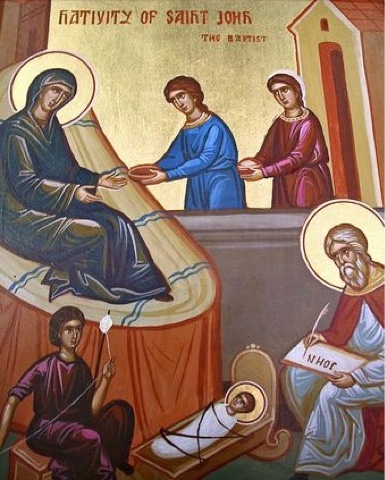
Saturday of the Third Week of Advent - Hark, the Herald – The son of Zechariah


When the time arrived for Elizabeth to have her child she gave birth to a son. Her neighbors and relatives heard that the Lord had shown his great mercy toward her, and they rejoiced with her. When they came on the eighth day to circumcise the child, they were going to call him Zechariah after his father, but his mother said in reply, “No. He will be called John.” But they answered her, “There is no one among your relatives who has this name.” So they made signs, asking his father what he wished him to be called. He asked for a tablet and wrote, “John is his name,” and all were amazed. Immediately his mouth was opened, his tongue freed, and he spoke blessing God. Then fear came upon all their neighbors, and all these matters were discussed throughout the hill country of Judea. All who heard these things took them to heart, saying, “What, then, will this child be?” For surely the hand of the Lord was with him. 

Introductory Prayer: Lord, as I humbly kneel before you in prayer, I recognize your power and glory. Without you, I am nothing, but with you I can do all things. With this trust, I implore you to help me make good use of this time of prayer as an expression of my deep desire to love and imitate you. I am here to please and glorify you.

Petition: Lord, help me to appreciate more deeply the role of parents and families as domestic churches.

  1. Amazing Grace: Elizabeth and Zechariah received the great grace of a child in their old age. And not just any child: he was John the Baptist. To ready him for his great vocation, he would need the love and guidance that are unique to parents. Great people often trace their path from the love of a mom or dad (frequently both), who might remain hidden from the world. Am I grateful to my parents for what I received from them? Am I regularly seeking what is truly best for my spouse and children and not just what seems best in the eyes of the world?
  1. God’s Call: The child would not be named after his father, but rather would receive the name God chose. The great tension in the life of a child (and sometimes an adult) is the close identity they have with a parent ― or with a parent’s plans for their life. In truth, our identity rests in our heavenly Father. God alone gives us meaning and a vocation in life. Could there be expectations of a parent or other family member that hold me back from God’s plan for me? Or, if I am a parent, do I unjustly impose my plans on my children? Do I interfere in their vocation? In their marriage?
  1. Zechariah’s “Yes” – Zechariah’s voice returns only after he acquiesces to God’s plan and agrees to the child’s name. When we finally say “yes” to God in our life, that’s when we find the deepest meaning of our lives. That’s when we can express ourselves the best. Am I keeping God waiting?

Conversation with Christ: Lord, Zechariah took a long and winding road on his path over nine months. Let me see my own life as a path, and have patience with those who are still on their path.

Resolution: Today, I’ll say “yes” to one thing that God has been asking of me.

Thursday, December 21, 2017

Friday of the Third Week of Advent - Favor Is the Key


Mary said: “My soul proclaims the greatness of the Lord; my spirit rejoices in God my savior. for he has looked upon his lowly servant. From this day all generations will call me blessed: the Almighty has done great things for me, and holy is his Name. He has mercy on those who fear him in every generation. He has shown the strength of his arm, and has scattered the proud in their conceit. He has cast down the mighty from their thrones and has lifted up the lowly. He has filled the hungry with good things, and the rich he has sent away empty. He has come to the help of his servant Israel for he remembered his promise of mercy, the promise he made to our fathers, to Abraham and his children for ever.” Mary remained with Elizabeth about three months and then returned to her home.

Introductory Prayer: I love you, Lord, for you have loved me first. You have allowed me to see your provident hand in so many events of my life; how can I not believe in you? These days of Advent have slipped away so quickly. You are almost at my doorstep, ready to knock. I want to be ready for your arrival on Christmas Day. Therefore, I pour out my humble plea before you.

Petition: Lord Jesus, mark my life with gratitude.

1. The Key Word: The Magnificat, and indeed the entire history of salvation, can be summarized in the word “favor”. This is the true motive of Christmas. God looks with favor (or good will) upon mankind. Many times, we see our spiritual life as the effort we make to become pleasing in God’s eyes, drawing his blessings down upon us. This would mean that in some way we bring about our own growth in holiness. This is not the case: God is never “obliged” to grant us his grace. We do not “deserve” anything from God. Our spiritual life should consist in presenting ourselves before God as we truly are: sinners. By placing our weakness before his omnipotence, we draw down his favor to lift us up from our misery and to adopt us as his children. This is what happened as he “looked with favor on the lowliness of his servant (Mary).”

2. The Gift of Himself: To demonstrate his immense love for us and to give himself to us, God becomes one of us. Love makes us seek to become more like our beloved. How could God become more like his beloved creature? He not only became man, but he shared the lot of the poorest of the poor. Very few humans, even among the paupers, have been born in a stable. How many babies are laid in the feeding trough of a cow or horse? Well, that is exactly what a manger is. Though he was rich (he was God almighty), he became poor, to enrich us with his poverty. We need to ask ourselves what we are doing to become more like our beloved. What are we doing to imitate Christ in his gift of self? Have we learned to put aside our whims and fancies in order to do the things that are pleasing to our spouse, children or parents? These are the ways to prepare ourselves for a grace-filled Christmas.

3. Abundant Blessings: The rest of the Magnificat is a glorification of God, recognizing the favors he bestows upon those who love him. All generations will call us “blessed.” God will show the might of his arm, he will lift up the lowly, and the hungry he will fill with good things…. We truly have so much for which to be thankful. The challenge of our Christian lives is to be mindful of our blessings and mark our actions with the seal of gratitude. We glorify God and we bless God when we try to respond according to all the good he has done in our lives. Then in turn, others will call us blessed, because our filial attitude opens the door for God to enter in and do still more good through us. Do I count my many blessings often? Do I truly seek to “repay” God by cooperating, and am I aware that in return he will bring about still more good and bless me more?

Conversation with Christ: Lord, as I prepare my soul for your coming this Christmas, I invite you to enter my humble dwelling. Please do not pass by without bestowing your blessings upon my poor soul. I need your grace. I will not leave your presence today without at least a crumb from your banquet. Allow me to thank and praise you for your infinite mercy as you look upon your lowly servant.

Resolution: Today, out of gratitude for the many blessings I have received, I will give something good to someone in need.

Wednesday, December 20, 2017

A Journey of Faith and Love - Fourth Week of Advent


During those days Mary set out and traveled to the hill country in haste to a town of Judah, where she entered the house of Zechariah and greeted Elizabeth. When Elizabeth heard Mary’s greeting, the infant leaped in her womb, and Elizabeth, filled with the Holy Spirit, cried out in a loud voice and said, “Most blessed are you among women, and blessed is the fruit of your womb. And how does this happen to me that the mother of my Lord should come to me? For at the moment the sound of your greeting reached my ears, the infant in my womb leaped for joy. Blessed are you who believed that what was spoken to you by the Lord would be fulfilled.”

Introductory Prayer: Lord, help me to settle my mind and my heart. I know that you are present in this prayer. I want to turn aside all distractions. Increase my faith in your action in my life. You are leading me to yourself. Help me to place myself more fully in your hands. Increase my faith so that I will do anything and suffer anything for you. Use me as an instrument of your grace in the lives of those I meet today.

Petition: Lord, help me to follow Mary’s example of faith and love and bring you to others this Christmas.

1. Mary, Our Advent Model: Mary is truly the model of how we should be living Advent in preparing for Christ’s arrival. God the Father prepared her from the first moment of her conception to be the worthy mother of his Son. Like a faithful daughter of Israel, she had prayed throughout her youth for the coming of the Messiah. When she was a young lady, she discovered that she was part of God’s answer to that prayer, but in a way that would have far exceeded any Hebrew maiden’s prayers: not only would the Messiah be her son, but her son would also be God. Her “fiat”, her wholehearted “yes!” to the Archangel Gabriel, launched the proximate preparation for the birth of Jesus the Messiah. Let us enter into Mary’s response of faith, which is a guide for us along our own pilgrimage of faith. Let us listen to the beat of Mary’s contemplative heart, so that our Christmas may be as fruitful as that first Christmas.

2. Someone Who Loves Takes Notice of the Details: No sooner had the Archangel left Mary in Nazareth after announcing her important role in God’s incredible plan of salvation than Mary herself made plans to depart. She went with haste to help her elderly kinswoman Elizabeth who was pregnant for the first time. Gabriel had not instructed Mary to go to Elizabeth’s aid, nor did he suggest it. Mary’s great love was sufficient to cause her to spring into action and embark upon the long sixty-mile journey to Elizabeth’s hometown outside Jerusalem.   In undertaking this challenging and potentially dangerous journey, Mary showed — as she did at the wedding feast in Cana — that someone who loves takes notice of the details.  She showed that someone who loves does whatever possible to lend a helping hand, even at the cost of considerable sacrifice. We can imagine that this was Mary’s attitude from her earliest childhood.

3. Be A Missionary – Bring Christ!  – By going to Elizabeth’s aid, Mary – carrying the tiny Jesus in her womb – became the first missionary, the first bearer of the Good News that would change all of human history. Mary was able to bring incredible joy to both Elizabeth and John the Baptist in her womb precisely because she was bringing Christ. And Mary was able to burst out with her beautiful Magnificat for the very same reason. To bring joy to others this Christmas, we really have to bring them Christ. He is the greatest gift we could ever bring to someone we love — all the material goods in the world fall flat in comparison. Without sharing Jesus, we are not giving our loved ones anything that is truly lasting. Bring Christ and you bring everything.

Conversation with Christ: Lord Jesus, it is clear that your mother wants me to learn from her example. She inspires me to bring you to others this Christmas season. I know plenty of people who desperately need you in their lives, who need your forgiveness, who hunger for your love and presence, perhaps without even knowing it. I know that my loving relationship with you is never meant to be kept to myself; it is a gift meant to be shared. Your mother’s example shows me the way to live Advent well and explicitly challenges me to be a missionary by bringing you to the world.

Resolution: I will share my faith this Christmas season with a friend or relative in need.

Tuesday, December 19, 2017

Wednesday of the Third Week of Advent - Power of Personal Freedom


The angel Gabriel was sent from God to a town of Galilee called Nazareth, to a virgin betrothed to a man named Joseph, of the house of David, and the virgin’s name was Mary. And coming to her, he said, “Hail, favored one! The Lord is with you.” But she was greatly troubled at what was said and pondered what sort of greeting this might be. Then the angel said to her, “Do not be afraid, Mary, for you have found favor with God. Behold, you will conceive in your womb and bear a son, and you shall name him Jesus. He will be great and will be called Son of the Most High, and the Lord God will give him the throne of David his father, and he will rule over the house of Jacob forever, and of his kingdom there will be no end.” But Mary said to the angel, “How can this be, since I have no relations with a man?” And the angel said to her in reply, “The Holy Spirit will come upon you, and the power of the Most High will overshadow you. Therefore the child to be born will be called holy, the Son of God. And behold, Elizabeth, your relative, has also conceived a son in her old age, and this is the sixth month for her who was called barren; for nothing will be impossible for God.” Mary said, “Behold, I am the handmaid of the Lord. May it be done to me according to your word.” Then the angel departed from her.

Introductory Prayer: Heavenly Father, you have given Mary to us as our Blessed Mother. Thank you. I know that she constantly intercedes on our behalf and that you listen to her prayer. I am confident in your mercy and love. You are guiding me home to spend eternity with you. I place all my trust in you. I offer you my weak, but grateful love in return.

Petition: Lord, grant me the grace to embrace you in faith, hope, and love.

1. Sent from God: Too often we attribute too much of our achievements to our own doing. Our education, wealth, or technological ability can lead us to have a false sense of security in our ability to shape our world. Today’s Gospel reminds us that God’s plan for the salvation of the human race is his own initiative. He sends his Son into the world at a precise time and in a precise place. He prepares Mary beforehand with everything she will need to fulfill her mission as Mother of the Redeemer – a mission that she accepts in freedom and through faith. I do well to realize more and more that God is also the true protagonist of my own life.

2. Do Not Be Afraid: One of the constant refrains of the Gospel is Jesus’ admonition: “Do not be afraid.” When the Lord draws near, our natural tendency is to be afraid. We can be afraid of his presence. We can be afraid of what he might ask of us. We can be afraid of our own limitations in the face of the call to true conversion and holiness of life. We can be afraid of the apparent obstacles along the path of Christian discipleship. Like Mary, we need to overcome our fear by embracing God’s will with faith and love. As our confidence in God increases, our fear decreases. As our love increases, our fear disappears. Of what am I afraid in my relationship with the Lord? Am I surrendering my fear by giving myself in faith?

3. May It Be Done to Me: What a truly incredible thing it is to make the salvation of the human race dependent upon the free response of Mary! Mary’s “yes” to God shows us the power and transcendence of personal choice. It also sheds light on the importance of our own personal “yes” to God with regard to his plan for our lives. Mary’s loving, faith-filled consent to a plan she did not fully understand becomes the model of our own daily consent to the divine will as it manifests itself in our daily lives.

Conversation with Christ: Lord, I have remembered through this meditation that you are the one guiding my life and all of history. I need to be mindful that you always intend good for me, even if it is painful and purifying. So I should never be afraid of your hand in my life.  I believe and trust in you my Lord, but increase my faith, hope and love.

Resolution: I will embrace God’s will today as Mary did — with faith and love.